
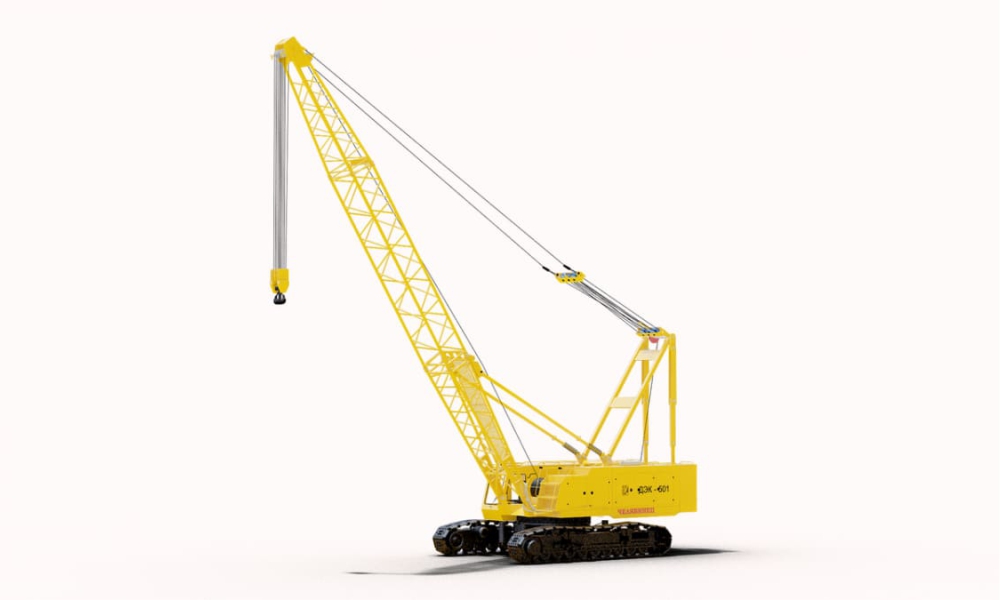
Boom crane is one of the most common types of lifting equipment, which differs in that the lifting mechanism is located on the blocks at the end of the boom or on the cart itself, which moves on it.
| Table | Table |
| Table | Table |
| Table | Table |
- The lifting capacity of the jib crane depends on the departure of the boom: the smaller the departure, the greater the load capacity and vice versa. Load capacity of crane equipment for excavators with buckets with a capacity of 0.4 m³; 0.65 m³; 1 m³ and 1.65 m³ is: 6.3 t; 10 t; 16 tons and 25 tons
- Boom cranes are often in demand in terms of logistics, construction of residential, industrial or commercial facilities.
- The jib type of cranes includes rotary cranes, the running gear of which is equipped with a fixed boom or tower-jib mechanism
- The main principle of the jib crane is to create a balance between the suspended load and the support
Boom crane is one of the most common types of lifting equipment, which differs in that the lifting mechanism is located on the blocks at the end of the boom or on the cart itself, which moves on it. Boom cranes are often in demand in terms of logistics, in the construction of facilities for various purposes (residential, industrial, commercial). The principle of operation is that cranes installed on the road are able to move quickly from one point to another, carrying out loading and unloading operations and thus saving time and money. The jib type of cranes includes rotary cranes, the running gear of which is equipped with a fixed boom or tower-jib mechanism. By type of chassis there are the following types of self-propelled jib cranes:
- Railway;
- Automobile;
- On a special chassis;
- Pneumatic wheels;
- Crawler cranes.
They all consist of running and pivoting devices, a non-rotating frame, a rotating platform and the boom itself. The lifting capacity of the jib crane depends on the departure of the boom: the smaller the departure, the greater the load capacity and vice versa.
Classification of jib cranes:- Self-propelled, having a lifting element mounted on the platform of a mobile running gear;
- Tower rotary cranes with an arrow on a vertical tower;
- Cranes with a flywheel. Although they are classified as tower cranes, but they have an arrow that can rise almost to a vertical position;
- Derrick cranes, which are rotary units with a vertical mast and supports that support the lifting element on the hinges;
- Portal and semi-portal cranes, which place the boom on the portal and semi-portal, respectively;
- Ship's cranes mounted on water means for unloading or loading the vessel;
- Mounting non-rotating cranes, which are installed directly on the site near the construction works.
- Ability to work with loads of different weights and dimensions;
- Install a jib crane in rough terrain;
- Carry out loading and unloading operations in different climatic conditions;
- Possibility to install the jib crane in the conditions of limited space of the city environment.
- Running device or swivel frame (if stationary crane);
- Control cabin;
- Arrow;
- The mechanism of fastening and lifting of cargo;
- Motor with rotation transmission system on winding drum;
- Tilt angle change system (depending on the selected method).
The whole mechanism is driven by a gasoline engine (diesel) or electric. It allows you to change the angle and direction of rotation of the platform with the control cabin. The main principle of the jib crane is to create a balance between the suspended load and the support. Existing counterweights or fulcrums create this balance. Support beams are specially provided in self-propelled units. In large construction units, a compensating load is installed, located on the back of the load.
Modifications of arrowsIn modern installations, two types of arrows are mainly used: lattice and telescopic. The crane boom of the first type has the form of a lattice rigidly welded from strong metal. It has a finite length. Therefore, the change in lifting height and load range can be carried out only by changing the angle. The second type allows you to change its length. This is done using a special mechanism that is actuated by various drives.
| Table | Table |
| Table | Table |
| Table | Table |
I want to get information