
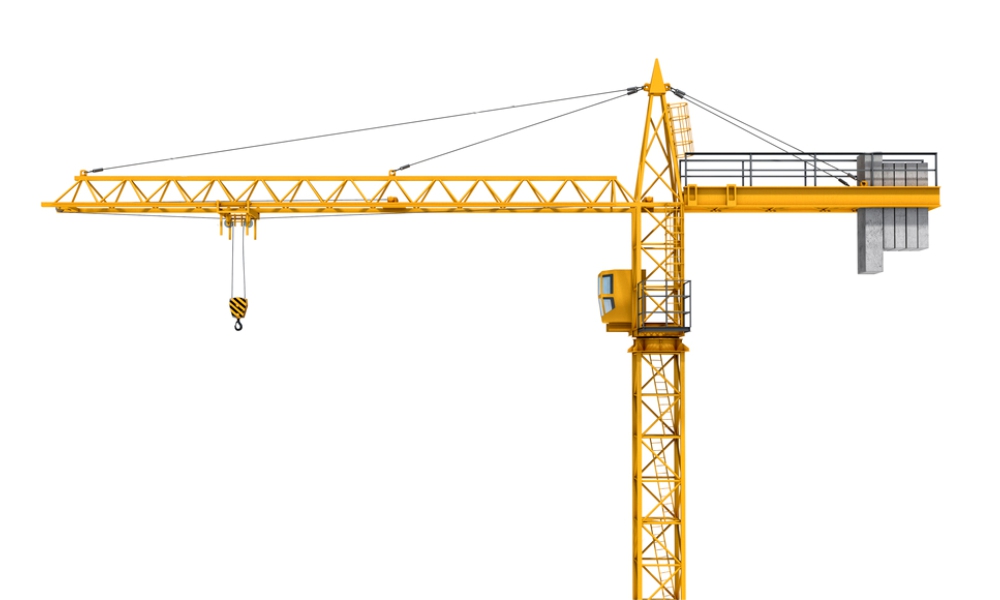
The tower crane successfully solves the problems of moving large objects and dimensions. It is also capable of solving a wide range of tasks related to lifting and moving loads.
| Table | Table |
| Table | Table |
| Table | Table |
- It has a capacity of up to 75 tons
- The main purpose is to serve the territory of construction sites of buildings and structures, warehouses, landfills, loading and unloading of transport materials.
- The most common is a construction tower crane, which lifts heavy loads to a given height; moves cargo within the construction site, unloads and loads vehicles.
- Tower cranes include lifting mechanisms with a rotary boom, winch and counterweight
The tower crane successfully solves the problems of moving large objects and dimensions. It is able to solve a wide range of tasks related to lifting and moving loads. Such devices include a lifting mechanism with a rotary boom, winch and counterweight. The boom, which is a load-bearing support made of metal, is mounted on top of the tower. The most common is a construction tower crane, which lifts heavy loads to a given height; moves cargo within the construction site, unloads and loads vehicles.
Tower crane design:- Support part (base);
- Swivel device;
- Horizontal guide (boom), which moves the hoisting winch;
- Vertical rack (tower);
- Cab with controls;
- Chassis (mechanism for moving the whole unit).
The principle of operation of the tower crane is based on lifting the object of the permissible mass with the help of a cargo winch. This design provides the required total weight of the boom and counterweight with the weight of the fixed object. The counterweight may consist of several typesetting elements, such as reinforced concrete structures. As a result, the sum of the stabilizing moments must always exceed the sum of the tilting moments. From this position the required boom departure is calculated. Ensuring the maximum area of coverage required for the movement of cargo is carried out by the departure of the boom, its horizontal rotation, the movement of the cargo winch and the movement of the unit.
The main areas of application of tower cranes:- construction of facilities for various purposes (residential buildings, industrial facilities, hydraulic structures and more);
- loading, unloading, moving cargo to the place of work.
In terms of mobility, such mechanisms can be stationary or mobile. The degree of its movement depends on the type of chassis.
- Constant length;
- Telescopic;
- Those that grow up from below;
- With variable angle of rotation.
The first type has a fixed height. It is set in a vertical position with subsequent fixation. A tower crane with a rotating tower is able to rotate around its axis.
By type of boom there are the following types of devices:- Lifting boom (allows you to change the lifting angle);
- Beam type system;
- Hinged dismembered construction.
In the first type, the boom is adjusted by a horizontal plane by turning relative to the hinge. They have high maneuverability, load capacity and high lifting height. They are quite easy to transport. In beam structures, the departure of the boom is regulated by moving the cart equipped with a trailer. This greatly complicates the design and increases the weight. The latter type of units has a high versatility. They are able to adjust the amount of boom departure in both ways (increasing the angle of elevation and the length of the horizontal guide). This expands their capabilities, but significantly increases their cost.
According to the method of installation, the types of tower cranes have the following performance:- stationary;
- self-lifting;
- mobile.
The first category includes mechanisms that are installed in a predetermined place. Without the ability to move. They are mainly used on construction sites. Mobile cranes include all units equipped with a running gear. They have good maneuverability, which increases their performance.
| Table | Table |
| Table | Table |
| Table | Table |
I want to get information